
How to unlock 27% more revenue from existing customers
We’re launching some free educational resources as a way to give back and say thanks.
The first is why paid growth in 2025 for B2B SaaS companies is so hard and one trick Wiz used to scale from $0-32b in 5 years that we’ve started leveraging with a lot of our consulting clients.

...now onto the article
Tableau's current pricing strategy perfectly demonstrates what I see many SaaS companies struggling with: leaving massive revenue on the table due to poorly structured pricing tiers.
Before showing you how the decoy effect can transform their monetization...
Q: What's the #1 problem with Tableau's current pricing page?
Take a minute to study their pricing structure.
Got it? Scroll down...

The main issue here is a pricing gap that forces customers into the lowest tier.
Tableau Viewer costs $15/month for basic dashboard access. Tableau Explorer jumps to $42/month - nearly 3x more expensive for "full self-service analytics."
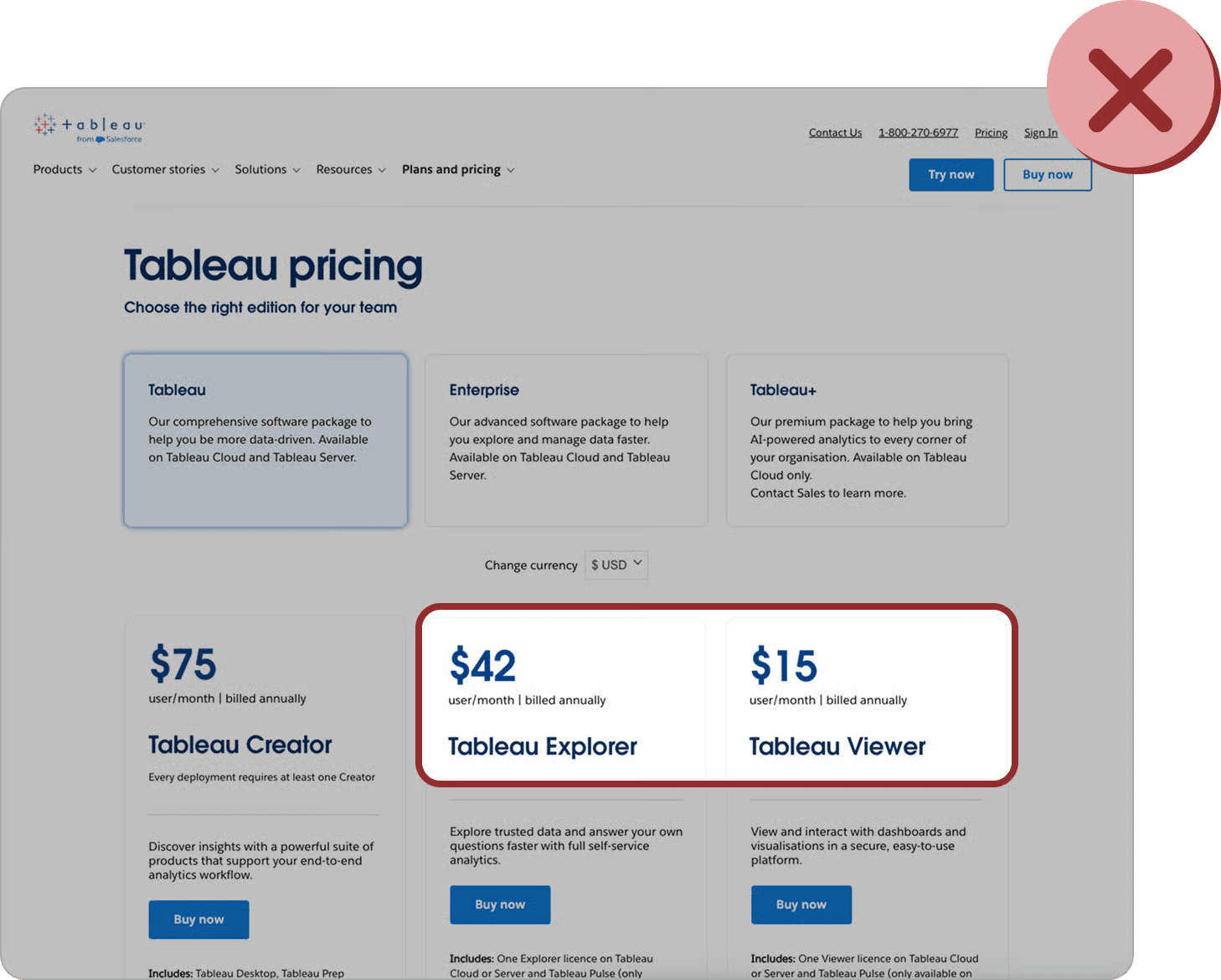
When finance teams see this gap, their brain immediately defaults to: "Let's put 90% of our team on Viewer and only give Explorer to the power users who absolutely need self-service analytics."
This creates massive psychological resistance:
- "Do we really need to pay 3x more per person?"
- "Maybe basic dashboard viewing is good enough for most people"
- "We can always upgrade later" (spoiler: they rarely do)
The result? Companies load up on the $15 plan and Tableau misses out on huge revenue potential from teams that would happily pay $19-22/month for better functionality.
Q: So how could Tableau dramatically increase their average revenue per customer?
Think about what pricing psychology principle is missing here.
The solution is below...

They're missing the decoy effect, one of the most powerful pricing psychology principles.
Instead of a massive price gap, companies use strategic decoy pricing to guide customers toward higher-value tiers.
Here's what this looks like for Tableau:
Change #1: Introduce the Decoy
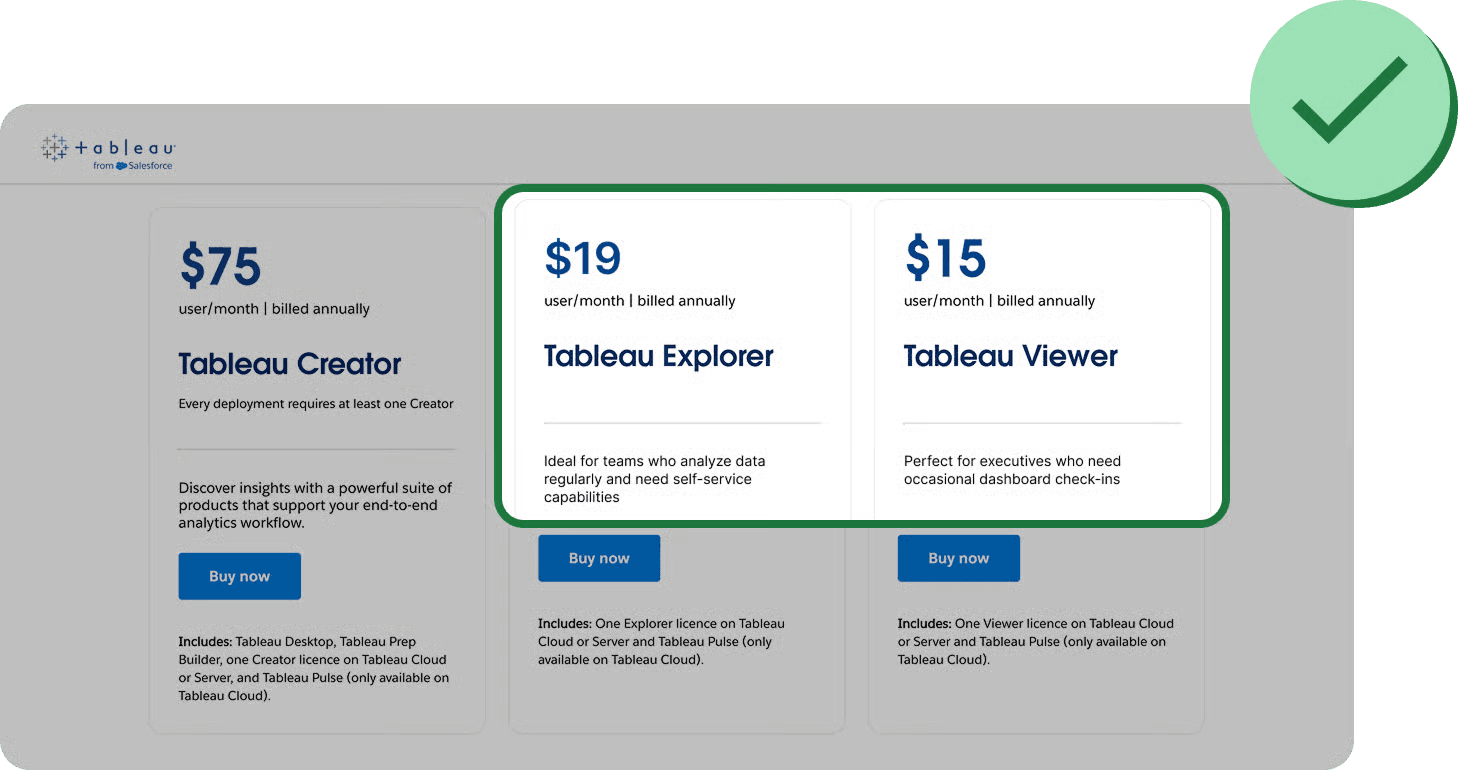
- Keep Tableau Viewer at $15/month BUT add restrictions (limit to 3 dashboards, view-only mode, no data exports)
- Price Tableau Explorer at $19/month (was $42) with full self-service analytics
- Keep Creator at $75/month for dashboard creation
Change #2: Reframe Value Positioning
Instead of presenting Viewer as the default choice, position it as: "Viewer: Perfect for executives who need occasional dashboard check-ins" and "Explorer: Ideal for teams who analyze data regularly and need self-service capabilities"
The Psychology Behind This:
When customers see $15 vs $19, the $4 difference feels minimal. But when they see $15 vs $42, they anchor on the huge gap and default to the cheapest option.
With decoy pricing, finance teams think: "For $4 more per person, we get full self-service analytics instead of just basic viewing? That's a no-brainer."
The Results?
This approach transforms customer thinking from "How do we minimize cost?" to "The upgrade is so cheap, why wouldn't we give our team better analytics tools?"
Instead of 80% of users on $15 Viewer, you get 70% on $19 Explorer, a 27% increase in average revenue per user without changing your core product functionality.